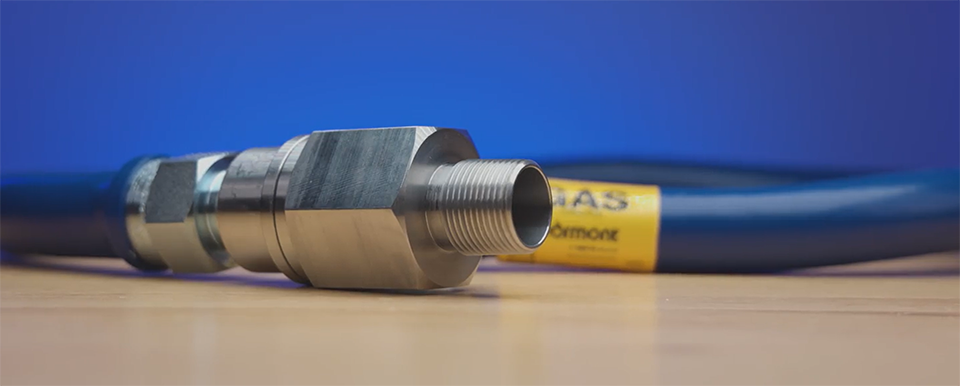
Dormont had already developed an Excess Flow Valve (EFV) for residential gas applications and wanted to extend that safety capability into commercial kitchens. An EFV is designed to trip at a defined flow rate to help prevent uncontrolled gas release if a downstream disconnection occurs, such as a broken line or a hose pulled from an appliance.
Daedalus began with collaborative ideation sessions, generating a broad set of concepts through whiteboard sketching and early CAD. We quickly narrowed the field to the most promising architectures based on part count, manufacturability and assembly simplicity, cost, and the ability to maintain performance at elevated temperatures (favoring robust mechanisms and materials appropriate for commercial environments). With leading concepts identified, we moved into hands-on prototyping and performance testing using 3D-printed parts. We evaluated each design for pressure loss in normal operation and for reliable reset behavior after a downstream issue was corrected. Testing clarified key tradeoffs. Some sliding mechanisms were overly intricate, with multiple contact points that introduced friction and occasional sticking during closure. Other designs achieved shutoff but restricted the normal flow path too aggressively, creating unnecessary pressure drop. Ultimately, we converged on an approach that balanced consistent trip performance with low restriction in everyday use. Daedalus supported the design through validation and certification, including ANSI Z21.93-2017 testing that covered functional performance as well as impact and drop requirements, and carried the product through release to production. The final design exceeded ANSI trip rating consistency requirements, demonstrated improved high-temperature capability compared with Dormont’s existing residential EFV, and maintained more stable trip behavior across temperature. A very successful project!